Blog
Published on: 31-08-2026
Author : PISPL Editor Team
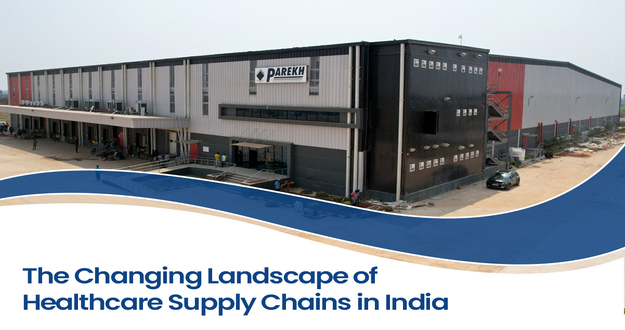
The Changing Landscape of Healthcare Supply Chains in India
India’s Healthcare sector is expanding across Pharmaceuticals, Medical Devices, and Consumer Healthcare. Alongside this growth, the supply chain supporting the sector is becoming more complex. Product sensitivity, regulatory norms, shorter fulfilment windows and wider market coverage are changing the way Healthcare companies approach warehousing, inventory control and distribution.
The traditional model of storing products in a few large facilities and moving them through standard distribution channels is no longer sufficient for every category. Healthcare supply chains now require greater control over storage conditions, batch visibility, shelf life, traceability and inventory availability. This becomes particularly important for companies operating across multiple states and serving distributors, hospitals, institutional buyers and specialised Healthcare networks.
From General Warehousing to Healthcare-Specific Infrastructure
One of the clearest shifts in Healthcare logistics is the growing need for infrastructure designed specifically for regulated products.
Pharmaceuticals & Medical Devices cannot always be handled like general merchandise. Storage conditions, hygiene controls, segregation, documentation and product handling procedures have to reflect the requirements of the product category.
Healthcare companies are therefore placing greater importance on facilities that can support:
- Ambient and temperature-controlled storage
- Batch and expiry management
- FEFO inventory movement
- Quarantine and released stock segregation
- Recall and reverse logistics processes
- Controlled access for high-value inventory
- Product-specific SOPs and documentation
- Value-added activities such as kitting, labelling, stickering and co-packing
Warehouse capacity still matters, but the way that capacity is managed has become equally important.
Cold Chain Is Becoming a Core Healthcare Capability
Cold chain was once associated with a relatively limited group of Pharmaceutical products. That is changing rapidly as biologics, vaccines, diagnostics and Speciality Pharmaceuticals become a larger part of the Healthcare ecosystem.
The requirement goes far beyond maintaining a set temperature inside a cold room. A dependable temperature-controlled operation involves temperature mapping, continuous monitoring, alarm management, qualified equipment, backup systems, controlled product movement and documented procedures for responding to temperature excursions.
Every handover also matters. Products can be exposed to risk during receiving, put-away, picking, staging and dispatch if suitable procedures are not followed.
Healthcare companies are therefore evaluating 3PL partners on their understanding of the complete temperature-controlled storage lifecycle rather than looking at cold room availability alone.
Inventory Visibility Has Become a Business Requirement
Healthcare inventory carries a distinct set of operational risks.
A stock-out can affect product availability in the market. Excess inventory, on the other hand, can increase expiry exposure and working capital pressure. Healthcare companies need to know exactly what inventory is available, where it is located, which batch it belongs to and when it is due to expire.
Warehouse Management Systems now play a central role in Healthcare 3PL operations. Batch-level visibility, FEFO logic, inward and outward transaction records, stock status and inventory reconciliation provide greater control over inventory across locations.
This becomes even more important when companies move from a single warehouse model to a regional or Pan-India warehousing network. Physical presence across several cities must be supported by consistent inventory information across those locations.
Speciality Pharma and MedTech Are Changing Storage Requirements
The growth of Speciality Pharma, Biologics, and Diagnostics is also changing the role of the warehouse.
Many products in these categories are high-value, sensitive to environmental conditions or available in multiple models, configurations and pack sizes. Medical devices may require demo inventory, consignment stock, accessories, spare parts or product kits to be maintained separately from standard saleable inventory.
Speciality Pharmaceutical products may require tighter controls around storage conditions, batch handling and product movement.
As a result, Healthcare warehousing increasingly requires flexible storage configurations, defined handling protocols and stronger inventory controls. The warehouse is becoming an active part of the product lifecycle rather than simply a location where inventory waits for dispatch.
Healthcare Networks Are Expanding Beyond Major Metros
Healthcare demand in India is no longer concentrated only in the largest metropolitan markets.
Tier 2 and Tier 3 cities are seeing greater access to diagnostics, hospitals, speciality care, pharmacies and medical technology. For Healthcare companies, this has a direct impact on warehouse network design.
Operating from a single national warehouse can result in longer replenishment cycles and greater dependence on long-haul distribution. Regional logistics centres allow companies to position inventory closer to markets while maintaining defined service levels.
This makes network planning a more strategic discussion. Companies are evaluating where inventory should be positioned, how much stock each region requires and whether their warehousing network can support expansion into additional markets.
Compliance Is Moving Closer to Everyday Operations
In Healthcare logistics, compliance cannot function as a separate activity that becomes important only during an audit.
GDP requirements, ISO-certifications, documentation, traceability, personnel training, deviation management, CAPA and change control have to be reflected in routine warehouse operations.
Healthcare companies are also looking beyond certificates during 3PL evaluations. Questions increasingly focus on how SOPs are followed, how temperature records are maintained, how deviations are investigated, how personnel are trained and how inventory can be traced through warehouse transactions.
The quality system has to be visible in daily operations, not just in documentation.
What Healthcare Companies Should Assess in a 3PL Partner
As Healthcare supply chains become more specialised, selecting a 3PL partner requires more than comparing warehouse space and commercial rates.
Important evaluation areas include Healthcare-specific infrastructure, temperature-control capability, WMS functionality, batch and expiry management, network reach, quality systems, trained personnel, scalability and value-added capabilities.
The partner should also be able to support changing product portfolios and geographic requirements without compromising established quality procedures.
Preparing for the Next Phase of Healthcare Growth
Healthcare supply chains in India are moving towards greater specialisation, stronger process control and wider geographic coverage. Warehousing is becoming increasingly connected with product integrity, compliance, inventory planning and market availability.
PISPL supports Healthcare companies through specialised warehousing, temperature-controlled infrastructure, inventory management, value-added services and a nationwide network of Integrated Logistics Centers. These capabilities are designed around the requirements of Pharmaceuticals, MedTech and Consumer Healthcare supply chains.
As Healthcare companies enter new markets and introduce more specialised product categories, the role of the 3PL partner will continue to become more significant. Building the right warehousing and distribution foundation today will determine how effectively healthcare supply chains respond to the demands of tomorrow.
Recent Post
India’s Medical Device Boom: What It Means for Warehousing and Distribution
The Changing Landscape of Healthcare Supply Chains in India

Why Chennai is Emerging as India’s Next Healthcare Supply Chain Hub
How 3PL Companies Help Healthcare Brands Scale Faster