Blog
Published on: 30-09-2026
Author : PISPL Editor Team
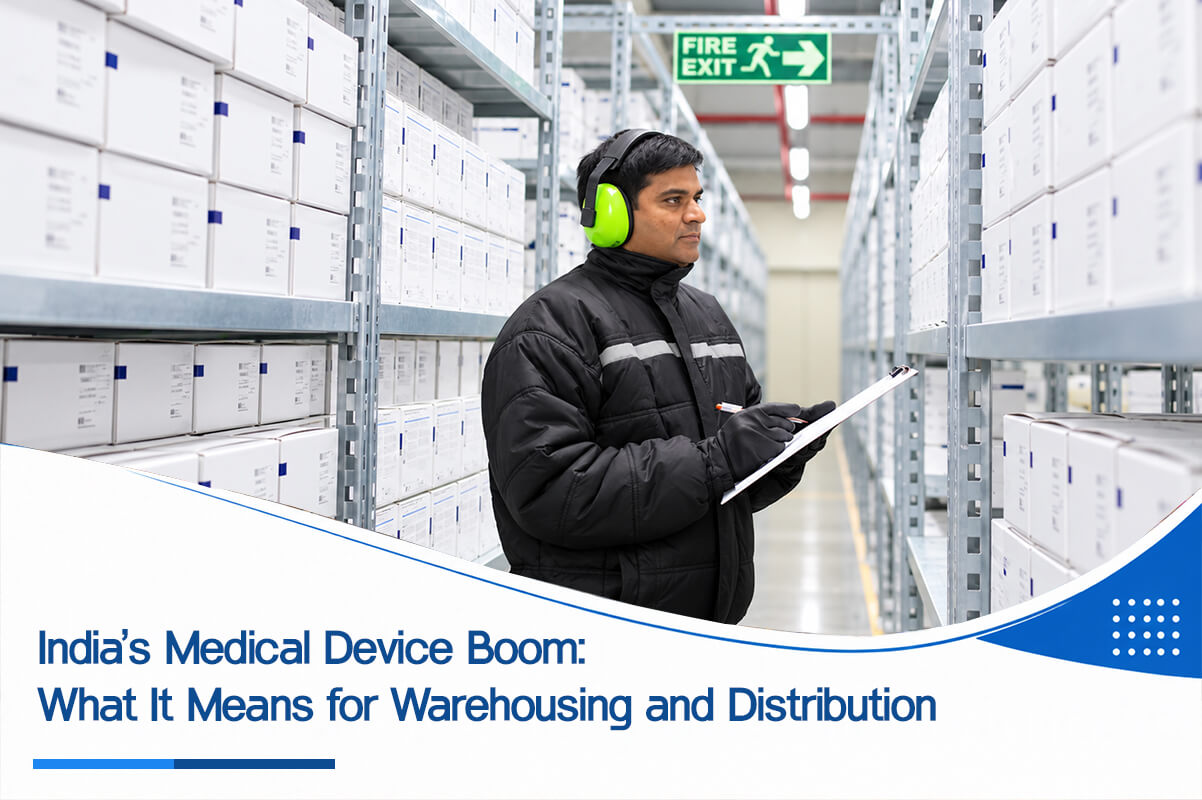
India’s Medical Device Boom: What It Means for Warehousing and Distribution
India’s Medical Device sector is moving through a period of rapid expansion. Demand is rising across diagnostics, surgical equipment, implants, monitoring systems, imaging devices, consumables and home Healthcare products. Domestic manufacturing is also gaining momentum, while global manufacturers continue to deepen their presence in the Indian market.
For supply chain teams, this growth creates a very different operating environment from conventional pharmaceutical distribution. Medical devices vary widely in size, value, storage condition, shelf life and handling requirements. A Diagnostic Reagent cannot be stored in the same way as an Orthopaedic implant, while a capital Medical Device may require a completely different inventory and service model.
As product portfolios become broader and distribution networks extend into more cities, warehousing and distribution have to support far greater complexity.
Medical Devices Need More Than Standard Storage
The term “Medical Devices” covers an unusually diverse product universe. It can include small diagnostic consumables, Cardiac implants, Ophthalmic products, surgical instruments, large diagnostic equipment and electronic monitoring devices.
Each category creates its own warehousing requirements.
Some products require controlled ambient conditions. Others may need refrigerated storage. High-value implants demand strong inventory control and secure access. Electronic equipment may need careful handling and dedicated storage locations. Diagnostic products can have strict expiry and temperature requirements.
This makes warehouse design an important part of the supply chain strategy.
Storage configuration may need to combine pallet locations, shelving, bin storage, secure cages, temperature-controlled zones and designated areas for non-saleable inventory. The facility also has to accommodate quarantine stock, returns, demo equipment, spare parts and other inventory categories without compromising traceability.
Inventory Control Is Becoming More Complex
Medical Device companies often carry a large number of SKUs, models, sizes and configurations.
Orthopaedic products are a good example. A single procedure may require multiple implant sizes and associated instruments to be available. Similarly, Ophthalmology, Cardiac care and Diagnostics can involve specialised product variants that must be identified correctly at the time of picking and dispatch.
The challenge is not simply maintaining inventory. It is maintaining the right inventory in the right configuration.
Warehouse Management Systems can support serial number tracking, batch control, expiry management, stock status, location visibility and transaction history. For applicable products, FEFO principles also become important in reducing expiry exposure.
As portfolios expand, manual inventory practices become increasingly difficult to sustain. Accurate system records and defined warehouse processes become critical for maintaining product availability.
High-Value Products Require Closer Monitoring
Many Medical Devices represent significant inventory value despite occupying relatively little warehouse space.
Cardiac devices, implants, specialised surgical products and certain diagnostic systems can carry substantial unit value. This changes how storage, access control and stock reconciliation need to be managed.
Medical Device warehousing may therefore require restricted access for designated inventory, controlled handling of high-value products, separate storage for saleable, quarantine and returned inventory. For tracking serial number and batch-level traceability, defined cycle-counting procedures, documented movement between storage locations, strong reconciliation processes, CCTV coverage and controlled entry protocols.
The objective is to maintain accountability throughout the inventory lifecycle, from inward receipt to final dispatch.
Temperature Control Extends Beyond Pharmaceuticals
Cold chain is often associated primarily with Vaccines and Biologics, but Medical Devices and Diagnostics can also require specific environmental conditions.
Certain reagents, Diagnostic kits and Healthcare products may need refrigerated storage, while other devices must remain within controlled room temperature conditions.
The challenge becomes greater when one distribution centre handles several product categories with different storage requirements.
Temperature mapping, continuous monitoring, alarm systems, backup arrangements and documented excursion procedures therefore become important components of Healthcare warehousing.
The requirement is not limited to maintaining a cold room. Temperature controls must also be considered during receiving, staging, picking, packing and dispatch.
Consignment Stock Is Changing Inventory Models
Medical Device distribution can differ significantly from traditional wholesale models.
Certain products are maintained as consignment inventory close to hospitals or clinical locations. Companies may also operate demo stock, loaner equipment or instrument sets that move repeatedly between warehouses and customer locations.
This creates an additional layer of inventory complexity.
The 3PL may need to maintain visibility across saleable stock, consignment inventory, demo units, instrument sets, returns and replacement products. Each category requires defined ownership status, system identification and movement controls.
For manufacturers, this level of visibility becomes particularly important as the number of markets and customer locations increases.
Spares and Service Support Are Becoming Part of the Supply Chain
Growth in capital Medical Equipment also increases the importance of after-sales support.
Diagnostic equipment, imaging systems and other technical devices may depend on spare parts for maintenance and repair. Delays in spare availability can affect equipment uptime at hospitals, laboratories and diagnostic centres.
This means the warehouse may need to support spare parts alongside finished Medical Devices.
Spare inventories often involve large SKU counts and comparatively low movement per item. The operational challenge lies in maintaining accurate stock records and making critical parts available when service teams require them.
Reverse logistics also becomes relevant when defective parts, returned equipment or repairable components have to move back through the network.
Value-Added Services Are Moving Closer to Warehousing
Medical Device companies increasingly require activities beyond basic receiving, storage and dispatch.
Kitting, de-kitting, bundling, labelling, stickering, stamping and co-packing can form part of the warehouse operation depending on the product and regulatory requirement.
Bringing these activities into the logistics facility can reduce unnecessary product movement between multiple locations and provide better control over inventory during value-added processes.
The warehouse is therefore becoming a broader operational platform rather than simply a storage point.
Distribution Networks Need to Follow Healthcare Expansion
Medical Device demand is expanding beyond major metropolitan markets. Hospitals, diagnostic centres and speciality Healthcare facilities are growing across Tier 2 and Tier 3 cities.
For manufacturers, this places greater importance on inventory positioning and regional warehousing.
A Pan-India network of logistics centres can help companies hold stock closer to important markets while maintaining common operating procedures across locations. Regional inventory planning also helps address different demand patterns without relying entirely on a single central warehouse.
Building Supply Chains for the Next Phase of MedTech Growth
India’s Medical Device growth will place increasing pressure on warehousing systems, inventory controls and distribution networks.
The companies best prepared for this environment will be those that treat logistics as part of their commercial and quality framework rather than as a downstream activity.
PISPL supports MedTech supply chains through specialised Healthcare warehousing, temperature-controlled infrastructure, inventory management, consignment stock handling, demo equipment management, spare parts support, value-added services and a nationwide network of Integrated Logistics Centers.
As Medical Device portfolios become more specialised and market coverage expands, the role of the Healthcare 3PL will continue to grow. The next phase of India’s MedTech sector will require supply chains capable of handling greater product complexity, stronger traceability and broader geographic reach.
Recent Post
India’s Medical Device Boom: What It Means for Warehousing and Distribution
The Changing Landscape of Healthcare Supply Chains in India

Why Chennai is Emerging as India’s Next Healthcare Supply Chain Hub
How 3PL Companies Help Healthcare Brands Scale Faster